National Prune Day

June 15 is celebrated as National Prune Day. For more information, visit the California Prune website.
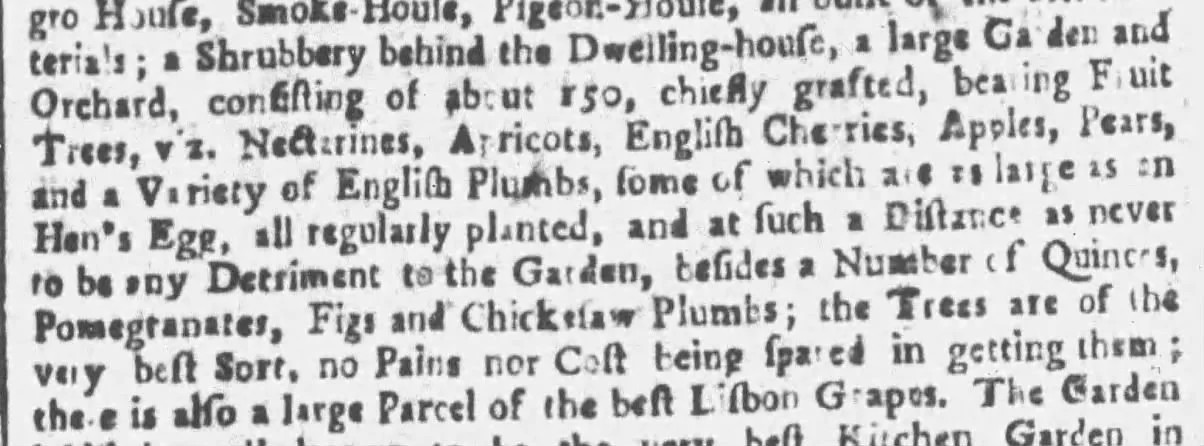
The South-Carolina and American General Gazette, Mar 13, 1777.

There are over a dozen varieties of plums native to North America. Early colonists would have had access to the wild American plum, Prunus americana, here in South Carolina. Prunus angustifolia, the Chickasaw plum, is native to the continent, but was likely introduced to South Carolina via Native American trade. Notice in the 1777 property ad that the orchard contains plum trees of both English and Chickasaw varieties. Henry Laurens also introduced French plum trees into the Lowcountry. As early as 1739, traders in Charleston were importing “Raisins of the Sun and Prunes” for the colonists’ enjoyment. (An interesting, non-prune-related note: importer William Welfit noted in the same July 1739 notice that he would take payment in “Good Rice, Pich (sic.), Tar and Deer Skins” in addition to “ready Money.”)

Horticultural experimentation with native plums occurred throughout the following centuries, but most larger cities and markets relied on important or non-native plums for their money-making. Not all plums are good for making prunes; both the wild American plum and the Chickasaw plum can be dried to eat, but other varieties are better for this purpose. Today, prunes most commonly come from the European plum.
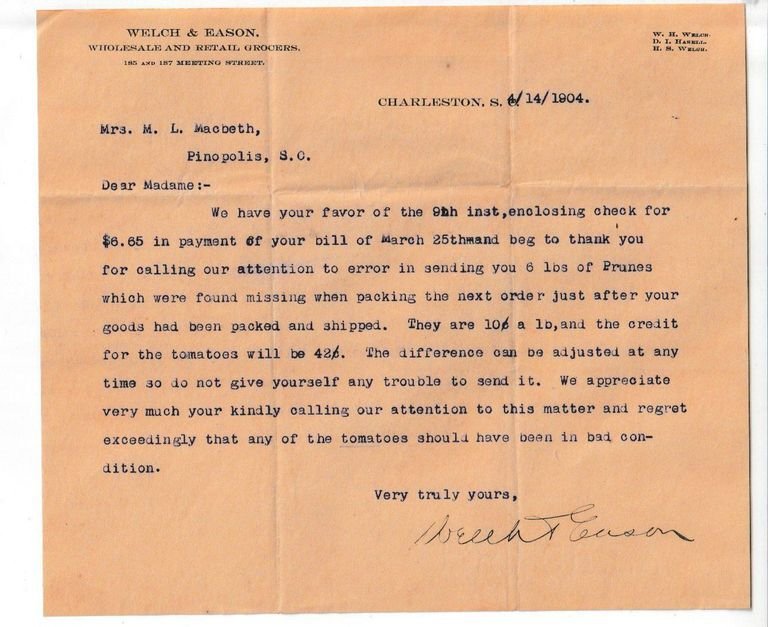
MSS02.2.31

In the spring of 1904, Mrs. Mary Louise (Gaillard) Macbeth of Pinopolis ordered groceries from Welch & Eason in Charleston. She was accidentally sent six pounds of prunes! We don’t know if Mrs. Macbeth settled up with the grocers, but we do have several other receipts from the Macbeth family around the turn of the 20th century.
WWI Story: Ruth Evelyn Bunch

Ruth Evelyn Bunch was born in Town of St. Stephen, SC in February 1901. Her parents were Edward and Mary Bunch.

By the fall of 1918, Bunch had moved to Charleston. She enlisted as a Landsman, Yeoman (F), U.S. Naval Reserve Force in September; it's possible that she lied about her age, because the "The Official Roster of South Carolina Soldiers, Sailors and Marines in the World War" claims she was born in 1899. Bunch was stationed at the Navy Yard in Charleston until Armistice Day.

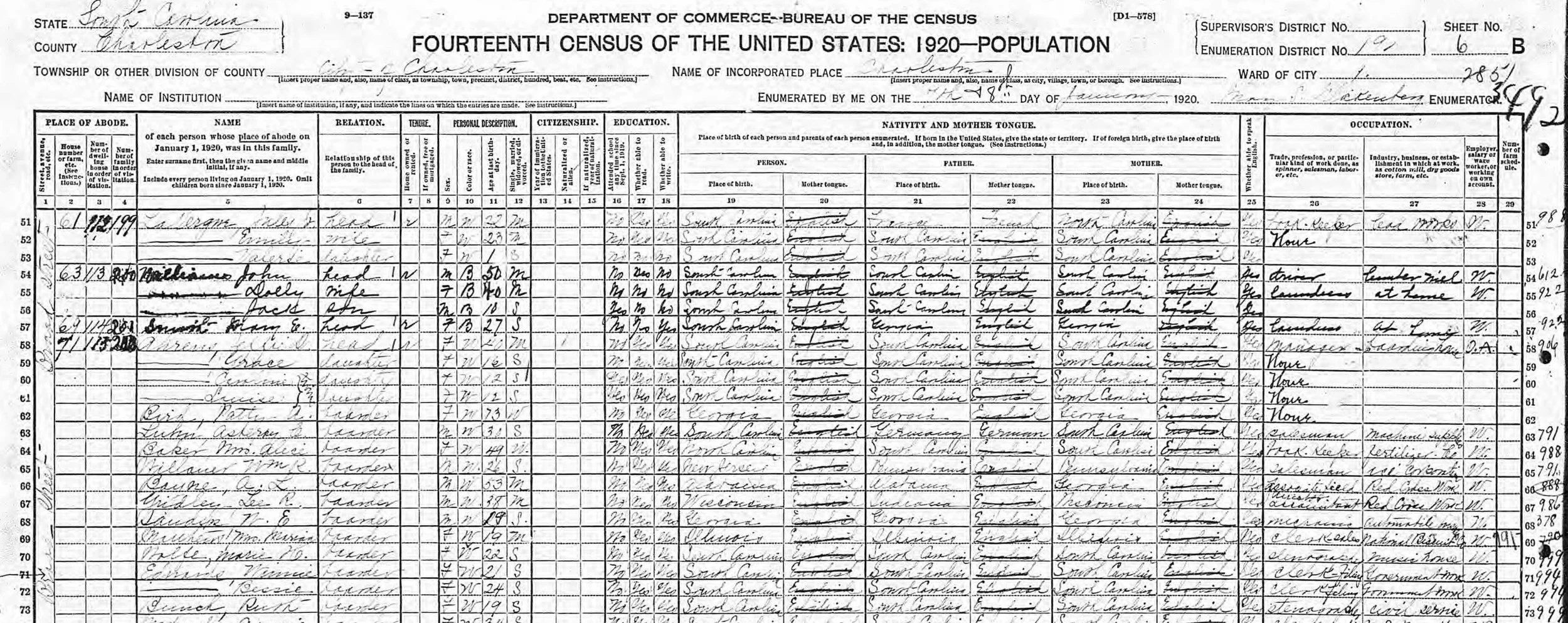
Bunch was discharged as a Yeoman (F) 3rd class in June 1920. Her occupation is listed as "civil service stenographer" on the 1920 census, and she worked as a stenographer at the Port Terminal
through at least 1921.

1920 census entry for Ruth E. Bunch (line 73).

By 1930, Bunch was married to accountant Harry Walker and living in Atlanta. Harry Walker had also been in the service, a sergeant in the Quartermaster Corps. Their time in Atlanta must have been brief, because they were living in the Charleston area again by 1935 and through Harry's death in 1967.

Bunch lived a long life, dying in Florida in 1991.

Artifact Spotlight: Gaillard Map

This is part one in a new blog series called “Artifact Spotlight.”

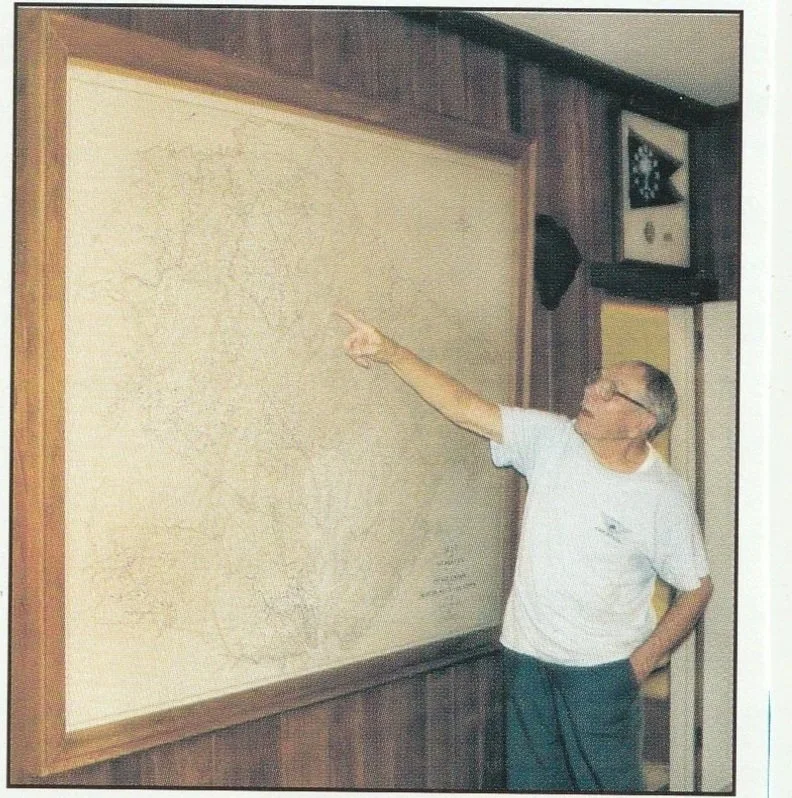
Upon walking into the Museum, one of the first things people see is the Gaillard Map hanging proudly on the wall. This map was donated in 2005 by the late former Charleston Mayor J. Palmer Gaillard, Jr.

Donor J. Palmer Gaillard Jr. points to Lake Moultrie on the large map. The photo was taken prior to the donation in 2005.

The map was first created in 1926 by Gaillard’s father, the late J. Palmer Gaillard (1874-1962). The senior Gaillard was a civil engineer and land surveyor. He worked for Harza Engineering of Chicago to do extensive surveys of the land that would become part of the Santee Cooper Project. Santee Cooper hired Harza (and Gaillard) in the summer of 1938.

The map was updated over the years, with the final changes coming in 1955. Landmarks such as the Santee Cooper Lakes and the Tailrace Canal were added as they were constructed. Most of the names of people and properties shown on the map date to the 1920s, giving a snapshot into the area before the Lakes.

Stop in soon to see the 6-foot map in all its glory, and see how many names you recognize on it!

From the Director's Desk

This post was originally published on Facebook on May 23, 2026.

From the Director's Desk:

Former director Michael Coker welcomes current director Chelsy Proper to the Museum family in 2019.

Happy Saturday, y'all! Today marks my 7th anniversary at the Berkeley County Museum. (Technically I started in April 2019, but May 23 is the day I was officially on my own.) Thank you to the Museum Board, my coworker and volunteers, my colleagues in local history and tourism, and, most importantly, YOU: the Museum supporters and community members who love our history as much as I do.

In the last 7 years, I've seen the Museum grow by leaps and bounds. From 2019's Pirate Festival to 2022's opening of Fort Fair Lawn to this past February's Revolutionary Berkeley Day, I've seen the community come out to our events and support us again and again. One of my favorite exhibits has been "Lowcountry Mourning in the Progressive Era," and judging by the compliments we received on it, y'all love it too! (Maybe it'll make a reappearance this fall....) I also love our state-of-the-art Revolutionary War kiosk, especially when I get to share the Revolutionary history of the neighborhoods of local students.

Again, thank you. Here's to 7 years and then 7 more!

National Iced Tea Day

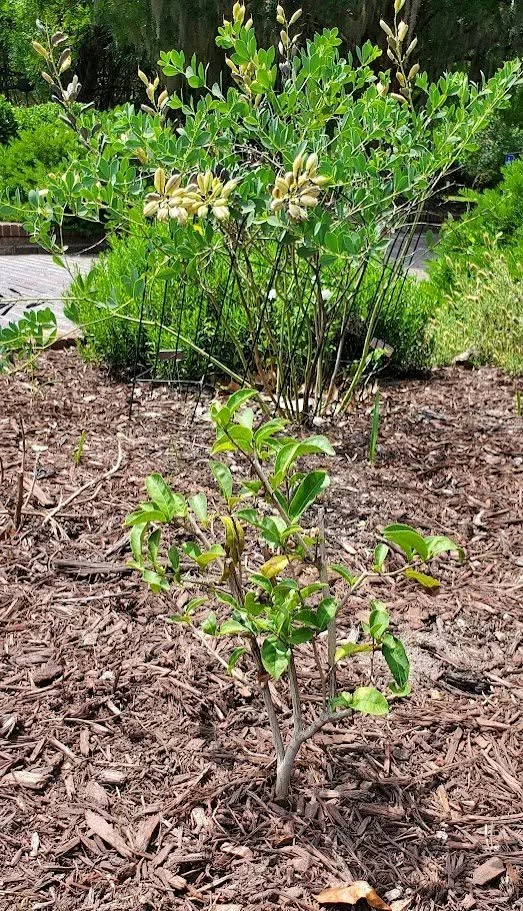
Today is National Iced Tea Day. Pictured here is one of 6 tea plants recently added to the Museum gardens.

Though tea was consumed locally in the 17th and 18th century, it was mostly imported; Native Americans consumed caffeinated tea-like drinks made from yaupon, and this "Carolina tea" was eventually (and briefly) adopted by the white colonists.

French botanist Francois Andre Michaux first planted Camellia sinensis in the Lowcountry in 1799. (If you're familiar with the area around the Charleston International Airport, his name may ring a bell!) This tea did well but was generally unpopular because the flavor was different than the usual bohea or green teas.

Dr. Junius Smith started a commercial tea farm in Greenville in 1848, but it only lasted a few years because of his untimely death. Other tea farms came and went through the following decades. In 1893, Pinehurst Plantation in Summerville plucked its first native-grown tea. Pinehurst flourished until 1915.

In the 1960s, Lipton Tea Company took root cuttings from the former Pinehurst site and started new farms in Summerville and on Wadmalaw Island. In 2003 the Wadmalaw farm was purchased by Bigelow, who still own and operate Charleston Tea Garden today. The American Black Tea grown there is the only commercially-sold tea grown in the United States.

Since 1995, iced tea has been the official Hospitality Beverage of South Carolina.